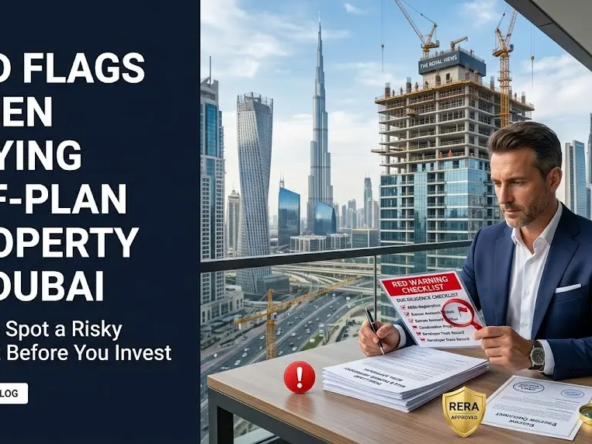
Dubai’s off-plan market is genuinely one of the better places in the world to invest in property. Low entry prices, flexible payment plans, strong appreciation, and no property tax make it attractive for buyers from all over. Most projects deliver what they promise. Most developers are legitimate.
But not all of them. And the buyers who lose money in Dubai’s property market are almost always the ones who ignored signs that something was off. Not because the signs were hard to spot. Because they were excited about the deal and moved too fast.
This guide covers the red flags you should look for before putting money into any off-plan project in Dubai. None of these checks takes more than a day. Together, they will tell you whether a project is safe to invest in or whether you should walk away. You can also start by browsing only verified off-plan projects in Dubai on My Off Plan Investment, where every listing has already passed the basic checks.
Red Flag 1: The Developer Cannot Show You a RERA Registration Number
This is the first thing you ask. Not the price, not the floor plan, not the payment plan. RERA registration.
RERA stands for Real Estate Regulatory Authority. It is the Dubai government body that licenses developers and approves projects. Before any developer can legally sell off-plan property in Dubai, they must be registered with RERA. Before any specific project can be offered to buyers, that project must also be registered separately.
Checking is simple. Download the Dubai REST app, which is the official free app from the Dubai Land Department. Search for the developer by name. If they do not appear, or if their licence is not active, stop the conversation there.
Then search for the project name and confirm it has its own registration number. A RERA-registered developer selling an unregistered project is still a problem. You need both. Every developer listed on My Off Plan Investment has verified RERA registration and active project approvals.
Red Flag 2: They Cannot Give You Escrow Account Details
Dubai law requires every off-plan developer to hold all buyer payments in a RERA-approved escrow account. This is a separate bank account registered specifically for each project. The developer cannot access this money freely. It can only be released in stages as construction is verified to have progressed.
Before you pay anything, ask the developer or their agent: What is the escrow bank name, and what is the escrow account number for this project? A legitimate developer gives you this information without hesitation. It is standard.
If the answer is vague, if you are told the account is being set up, or if you are given a regular company bank account instead of an escrow account, do not pay. This is the most important financial protection you have as an off-plan buyer in Dubai, and if it is not in place, your money is at risk.
Red Flag 3: The Price Is Noticeably Lower Than Everything Around It
A price that looks too good to be true usually is. In Dubai’s property market, prices in any given area are fairly consistent across comparable projects from established developers. If a project is priced significantly below everything else around it, there is a reason.
Common reasons include an underfunded developer who needs cash quickly, a project that has not received full approval yet, a developer with a poor delivery record who has to discount to attract buyers, or, in the worst cases, a fraudulent scheme.
This does not mean you should never buy in the lower price range. Newer or smaller developers sometimes offer genuinely competitive pricing. But when the price is substantially below market, your due diligence on the developer needs to be proportionally more thorough. Check how many projects they have completed and delivered. Talk to people who bought from them before. Visit completed buildings if they exist.
Browse off-plan properties by price and area to get a feel for what a realistic price range looks like in any given Dubai community before you compare a specific project against it.
Red Flag 4: The Developer Has No Track Record of Completing Projects
Every developer starts somewhere. That is true. But buying a first project from an unknown developer with no completed buildings is a gamble that does not need to be taken when there are so many established options available.
Before you commit, ask, ‘What have they built before?’ Ask for the names of completed projects and visit at least one of them. Talk to residents or previous buyers if you can. Check online forums and buyer communities for feedback. A developer who has delivered multiple projects on time and to a good standard is worth a premium over one who exists only in a brochure.
The developer profiles on My Off Plan Investment give you a clear look at delivery history for all major developers currently active in Dubai.
Red Flag 5: They Want You to Sign and Pay Today
Sales pressure is one of the oldest tactics in property sales, and it works because people are afraid of missing out. You get told there are only two units left at this price. You get told the offer expires at midnight. You get a call from the senior manager who can only hold the unit for a few more hours.
Real projects do not need these tactics. A good developer with a legitimate project has buyers. They do not need to trap you into a same-day decision on something that costs hundreds of thousands of dirhams.
If you feel pushed to decide before you have had time to verify the developer, check the escrow account, read the contract, and think clearly, that pressure itself is a red flag. Take at least 48 hours. If the unit is gone when you come back having done your homework, there will be another unit in another project.
Red Flag 6: The Sales and Purchase Agreement Has Vague Milestones
The Sales and Purchase Agreement, or SPA, is the legal contract between you and the developer. It governs everything: when you pay, what you are paying for, what the developer is obligated to deliver, and what happens if they do not.
One of the most common problem areas in off-plan SPAs is vague milestone definitions. A payment plan that says something like ‘payment of 10% upon completion of structure’ is not specific enough. What does completion of structure mean exactly? Which floor? Which stage of construction?
Vague milestones create disputes. When the developer claims a milestone is complete and asks for payment, and you disagree, a vague contract gives you no ground to stand on. Every milestone that triggers a payment should have a specific, verifiable definition. If the contract you are given does not have this, push for it. If the developer refuses to define their milestones clearly, that tells you something important about how they intend to manage the relationship.
Red Flag 7: No Physical Brochure, Approved Floor Plans, or Site Access
Legitimate off-plan projects are approved before they go on sale. They have registered floor plans, site plans, and approved architectural drawings that are part of the RERA project registration. A project that cannot show you official floor plans or whose sales team is working entirely from unregistered renders and verbal descriptions and has not completed the approvals process.
It is also reasonable to ask to see the site. Even before ground is broken, a legitimate project will have a registered location and an active construction permit. If the developer cannot tell you the exact plot number, cannot show you the DLD-registered project location, or becomes evasive when you ask about construction start dates, those are all warning signs.
The Quick Reference Table
Here is a summary of all the red flags and what to do when you see them:
| Red Flag |
Why It Is a Problem |
What to Do |
| No RERA registration |
Your money has no legal protection |
Check the Dubai REST app before paying anything |
| No escrow account details |
A developer can spend their money freely |
Ask for the bank name and account number in writing |
| Price far below market rate |
The developer may be underfunded or fraudulent |
Research the developer’s delivery history thoroughly |
| No delivery track record |
High risk of delays or an incomplete project |
Ask for completed project references and visit them |
| Pressure to sign the same day |
Sales tactic to stop you doing due diligence |
Always take at least 48 hours before deciding |
| Vague payment milestones |
Disputes over when payments are due |
Get every milestone defined specifically in the SPA |
| No project brochure or floor plans |
The project may not be properly approved yet |
A real project always has registered floor plans available |
Before You Invest: A Simple Checklist
- Search the developer name on the Dubai REST app and confirm active RERA registration
- Search the project name separately and confirm it has its own RERA project number
- Ask for the escrow bank name and account number, and verify it independently
- Compare the price against similar projects in the same area
- Research completed projects from this developer and visit one if possible
- Take at least 48 hours before signing or paying anything
- Read every clause of the SPA or have a lawyer review it
- Get specific written definitions for every milestone that triggers a payment
The Easiest Way to Avoid Risky Projects
Everything in this guide is worth doing yourself. But one practical way to reduce the risk from the start is to only consider projects that have already passed these checks.
My off-plan investment works only with RERA-registered developers with verified escrow accounts and project approvals. Every project in the listings has been through a basic verification process before it appears on the platform. You can browse the full off-plan property listings in Dubai, explore developments across the UAE, or compare options by community and location.
If you have questions about a specific project or developer you have come across, get in touch through the contact page, and the team will give you an honest assessment.
Frequently Asked Questions
Q1. How do I check if an off-plan developer in Dubai is legitimate?
Download the Dubai REST app, the official free app from the Dubai Land Department, and search for the developer by name. If they appear with an active licence, they are RERA registered. Then search for the specific project name to confirm it has its own RERA registration number. Check the escrow bank details and verify them independently. These three steps together give you a strong indication of whether a developer and project are legitimate.
Q2. What is an escrow account, and why does it matter?
An escrow account is a separate bank account registered specifically for an off-plan project with RERA. Dubai law requires all buyer payments to go into this account, not into the developer’s general business account. The money can only be released to the developer in stages as construction is verified to have progressed. This protects buyers if the developer runs into financial difficulties. Before paying anything, always ask for the escrow bank name and account number and verify them on the Dubai REST app.
Q3. What should I do if an off-plan project price seems too cheap?
Investigate before you get excited. A price significantly below the market rate in the same area usually has a reason. Research the developer’s delivery track record on previous projects. Check how many completed buildings they have. Look for buyer reviews or forum discussions about their past projects. If the developer is legitimate with a good track record, a lower price can be a genuine opportunity. If they have no history or a poor one, it is a warning sign.
Q4. Is it safe to buy off-plan property in Dubai?
Yes, for the most part, if you do the basic checks. Dubai has strong regulations through RERA, including mandatory escrow accounts, project registration requirements, and buyer protection laws that are genuinely enforced. The buyers who get into trouble are almost always those who skip verification steps or are pressured into signing quickly. Do the checks outlined in this guide, and your risk drops significantly.
Q5. Where can I find safe, verified off-plan projects in Dubai?
My Off Plan Investment lists off-plan projects from verified, RERA-registered developers with confirmed escrow accounts and project approvals. Browse the Dubai off-plan listings to compare current projects, or explore the full UAE property listings across Dubai, Abu Dhabi, and Ras Al Khaimah.