Oqood
Most people hear the word Oqood for the first time at the worst possible moment. You have just agreed to buy an off-plan apartment in Dubai. The developer slides a stack of papers across the table. Your agent mutters something about “the DLD fee” and “Oqood registration.” You nod. You sign. You go home and Google the word at midnight, wondering what you actually agreed to.
This guide is the answer you should have gotten before that meeting.
Oqood is not complicated once someone explains it plainly. But the UAE real estate industry has a habit of using legal and Arabic terminology without ever stopping to break it down for the person handing over their savings. So let us fix that right now, from the beginning, in plain English.
The Word Itself
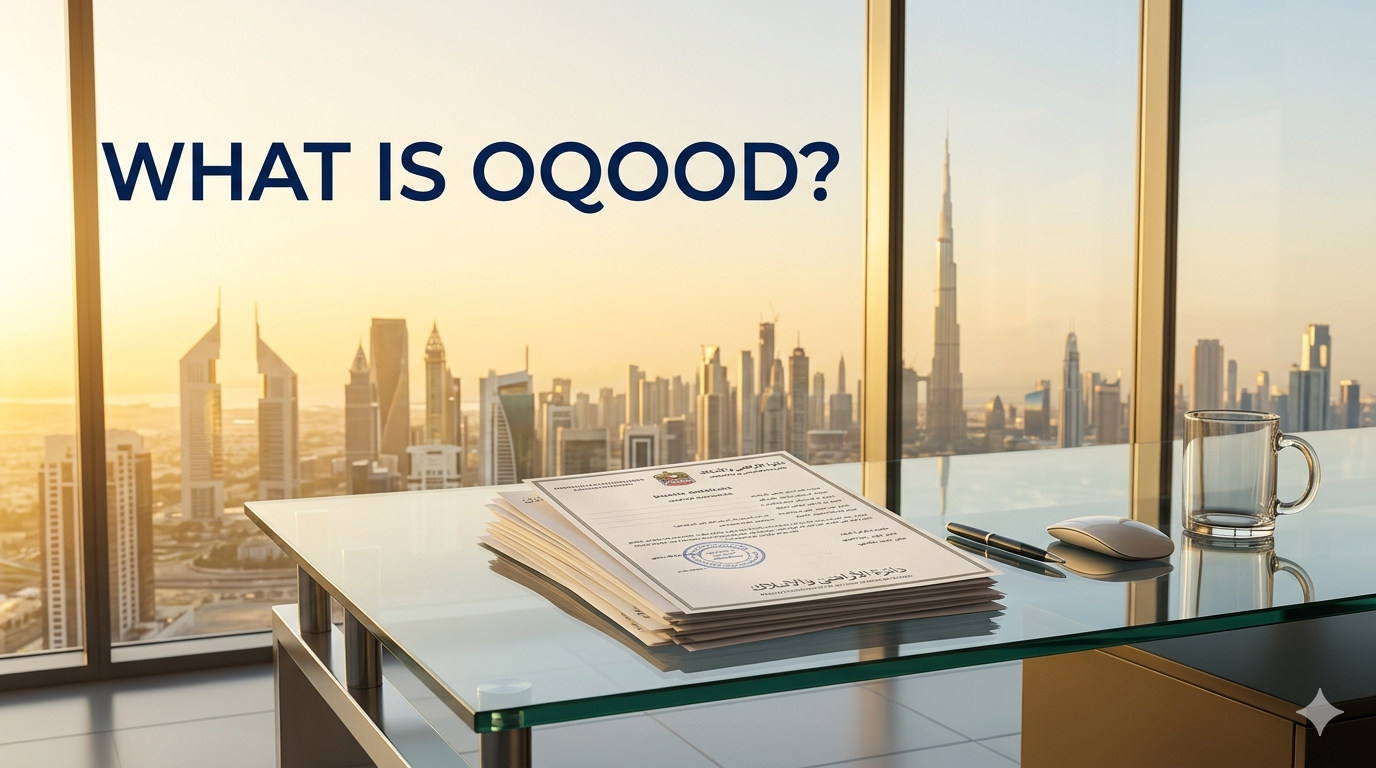
Oqood (عقود) is Arabic for “contracts.” Simple enough. In practice, though, it refers to something very specific: the Dubai Land Department’s official registration system for off-plan property purchases.
When you buy a property that is still being built, you cannot get a title deed yet. The building does not exist in its completed, legally transferable form. So there needs to be something in between. Something that says: this person paid money, this unit is theirs, the government knows about it. That something is the Oqood certificate.
Think of it like this. You book a flight months in advance. The seat does not exist yet in the physical sense that you are sitting in it. But your booking confirmation proves you paid, confirms your seat number, and gives you rights against the airline if something goes wrong. The Oqood certificate is your booking confirmation for a property that is still being built.
Why Oqood Exists at All
The UAE off-plan market is enormous. In 2025 alone, Dubai recorded over 134,000 off-plan transactions, which accounted for roughly 62.6% of all residential property sales that year. That is a staggering number of people buying properties they cannot walk into yet.
Before Oqood existed, that situation was genuinely dangerous for buyers. A developer could collect your payment, then sell the same unit to someone else. They could pocket your money without any obligation to hold it safely. If the project stalled or collapsed, you had a private contract and very little else. Fighting for your money back meant going to court with paperwork that had no official government backing.
Oqood was introduced to shut down that vulnerability entirely.
The moment your purchase is registered in the Oqood system, three things happen simultaneously. Your unit is locked to your name in the Dubai Land Department’s records. No one else can legally be sold that same unit. And your instalment payments are now legally required to flow into a RERA-supervised escrow account tied specifically to your project, not into the developer’s general bank account. Those funds cannot be touched by the developer until inspectors verify that construction milestones have been hit.
This is not optional. It is not a formality. It is the legal architecture that makes off-plan investment in Dubai safe, and it all hinges on the Oqood registration being done properly.
What Your Oqood Certificate Actually Contains
Once your purchase is registered and approved, the DLD issues your Oqood certificate digitally. It gets emailed to you and is also accessible through the Dubai REST app on your phone.
Here is what it contains:
Your full name and ID details, exactly as they appear on your passport or Emirates ID. If there is a spelling error, it needs to be corrected immediately. Not eventually. Immediately.
Property specifications: unit number, floor, building name, and project. The floor plan attached to your SPA should match this exactly. As of 2026, if the actual delivered area varies by more than 5% from what is on your Oqood, the DLD requires a mandatory price adjustment.
The purchase price and the full payment schedule, milestone by milestone.
Developer information, including their DLD registration credentials.
A unique certificate number and QR code for verification.
The moment you receive this certificate, open the Dubai REST app, go to “My Properties,” and confirm it is there and accurate. Every detail. This takes five minutes. Skipping it is one of the most common and most costly mistakes off-plan buyers make.
Is Registration Actually Mandatory?
100%. No ambiguity here. Under Law No. 13 of 2008, as updated through 2026, every off-plan sale must be registered with the DLD within 60 to 90 days of signing the Sales and Purchase Agreement. An off-plan sale that is not registered through Oqood is not just unprotected. It is legally void. The DLD does not recognise it. It does not exist in any government record.
What does that mean practically? If your purchase has not been registered:
You hold only a private contract between you and a developer. There is no government record of the transaction. Your payments may not be legally required to sit in a protected escrow account. Reselling the unit is nearly impossible. Financing it through a bank is nearly impossible. And if the developer faces difficulties or acts in bad faith, your legal position is drastically weaker than it should be.
Registration through Oqood is also what triggers escrow protection under Law No. 8 of 2007. It is not the SPA that triggers this protection. It is the registration. This is the detail that most buyers never learn until it becomes relevant in a dispute.
Who Actually Does the Registration?
The developer handles the submission. You do not go to the DLD yourself.
Here is how the responsibility splits. The developer’s legal team logs into the DLD’s Oqood portal, uploads your signed SPA and your identification documents, selects your unit from the project’s registered inventory, and submits the registration. The DLD reviews it, and once approved, the Oqood certificate is issued in your name.
Your job is two things. First, provide your documents quickly. Passport copy, Emirates ID (if you’re a UAE resident), and any other documentation the developer requests. Delays in registration are more often the buyer’s fault than the developer’s because the buyer was slow with their paperwork.
Second, pay the registration fee. More on that below.
One thing worth knowing: some developers batch their Oqood registrations weekly rather than submitting immediately after each sale. This is legal but annoying if you are waiting. If two or three weeks pass after your SPA signing and you have heard nothing about your registration being submitted, chase your developer. The 90-day window does not care whose fault the delay is.
The Documents You Need to Prepare
If you are buying as an individual:
A signed copy of your SPA, your passport copy, and your Emirates ID if you are a UAE resident. If the buyer is a minor, include the guardian’s letter and ID. If someone is buying on your behalf through a power of attorney, include the notarised POA.
If you are buying through a company:
Your valid trade licence, passport or Emirates ID of the authorised signatory, power of attorney if applicable, the company’s Memorandum of Association translated into Arabic by a legal translator, and a shareholder certificate. Foreign companies outside free zones additionally need a Ministry of Foreign Affairs attested MoA.
Practical advice: gather all of this before you sign the SPA. The clock starts on signing day. Coming back three weeks later scrambling for a translated MoA is not a position you want to be in.
The Fees: What You Are Actually Paying
The Oqood registration fee is 4% of your property’s purchase price, paid to the Dubai Land Department. This is the buyer’s obligation. It is not part of the property price. It is an additional cost on top.
Here is the full picture for 2026:
| What You Pay |
How Much |
| DLD Registration Fee |
4% of purchase price |
| Admin Fee |
AED 580 to AED 1,000 |
| Knowledge Fee |
AED 10 |
| Innovation Fee |
AED 10 |
To put real numbers on it: buy a property for AED 1,200,000 and your Oqood registration fee is AED 48,000. On a AED 2,000,000 purchase, it is AED 80,000. These are not small amounts. Budget for them before you sign anything.
Some developers run promotions where they cover the DLD fee as a launch incentive. If you see this offer, it is legitimate and valuable. But the default in 2026 is that the buyer pays.
If your purchase is financed through a mortgage, add 0.25% of the mortgage value as a separate mortgage registration fee.
Oqood vs Title Deed: The Comparison That Matters
This question comes up constantly. Here is the clearest way to think about it.
The Oqood certificate is your legal record in the Interim Property Register. It is a provisional ownership document that exists during the construction phase. It gives you real legal rights, but they are rights attached to a property that is still being built.
The title deed (called Mulkiya in Arabic) is your record in the Main Property Register. It is permanent proof of ownership for a completed property. It gives you full rights: sell freely, rent through Ejari, use as collateral for a standard mortgage, apply for utilities in your name.
|
Oqood Certificate |
Title Deed |
| Stage |
Under construction |
Completed |
| Legal register |
Interim Property Register |
Main Property Register |
| Can you sell? |
Yes, with conditions |
Full freedom |
| Can you rent it out legally? |
No Ejari without title deed |
Yes |
| Golden Visa eligible? |
Limited |
Full eligibility at AED 2M+ |
| Issued by |
DLD via Oqood portal |
DLD at handover |
The critical legal point: any off-plan sale not registered in the Interim Property Register via Oqood is void. This comes directly from DLD legislation. The Oqood is not a nice-to-have. It is the document that makes your sale real in the eyes of UAE law.
When the project is finished, and the developer gets a building completion certificate, your Oqood converts to a title deed. This conversion process typically takes 30 to 90 days from handover and must be initiated by the developer on their end. You cannot speed this up independently. What you can do is make sure all your payments are fully settled, because the DLD will not issue a title deed if any amount is outstanding, including service charge deposits or penalty fees.
Can You Sell Before the Building Is Finished?
Yes. This is called an off-plan resale or assignment of contract, and it is one of the primary strategies experienced UAE investors use.
Here is how it works. Most developers allow you to resell once you have paid 30% to 40% of the property value. The exact threshold depends on the developer and the project.
Step one: Request a No Objection Certificate (NOC) from your developer. Expect to pay AED 500 to AED 5,000 for this and wait 3 to 10 days. Step two: find a buyer and agree on a price. Step three: Both parties go to a DLD trustee’s office. Your original Oqood is cancelled. A new Oqood is registered in the buyer’s name. They take on the remaining payment plan instalments and pay the 4% DLD fee on the new agreed price.
The investor angle here is real. If you bought into a project early and the market has moved during construction, you can sell your contractual rights at a profit before you ever receive the keys. The appreciation is captured. The new buyer picks up from where you left off.
One important rule: you cannot list a property for off-plan resale on Property Finder, Bayut, or any major portal without a valid Oqood number and a Trakheesi permit. Make sure your documentation is in order before trying to market it.
Your Money Is Protected. Here Is How.
This part is worth reading slowly because it is the part most people never fully understand until they need it.
When your Oqood is registered, your instalment payments do not go to your developer’s bank account. They go into a project-specific escrow account that is monitored and regulated by RERA. The developer cannot access these funds freely. Money is released to them only after DLD-appointed inspectors verify that specific construction milestones have been reached, typically at 20%, 50%, and 80% completion.
If the project is cancelled for any reason, escrow funds are returned to buyers proportionally. This is not a promise from a developer. It is a government-enforced legal mechanism.
Now here is the part that matters: this protection only applies if your purchase has been properly registered through Oqood. Buyers who paid developers directly without Oqood registration do not benefit from escrow protection in the same way. Their money may have gone straight into the developer’s operating account. In a distressed project scenario, that distinction is enormous.
This is why your first check after signing any SPA should be confirming that your registration has been submitted, and your second check should be verifying it in the Dubai REST app.
Oqood and the Golden Visa: What You Need to Know
A lot of buyers in 2026 are purchasing UAE property with the Golden Visa in mind. The 10-year renewable visa is available to real estate investors with properties valued at AED 2,000,000 or more.
Off-plan properties can qualify. But the fine print matters.
A title deed is a stronger document for Golden Visa applications. An Oqood certificate, while a legally valid proof of ownership, is not always sufficient on its own depending on the stage of the application. Most investors who purchase off-plan with a Golden Visa intent either wait until handover when the title deed is issued, or they work with advisors who understand the current GDRFA requirements and can navigate the process correctly.
If this is part of your strategy, raise it with your advisor before you purchase, not after. The documentation requirements need to be understood upfront.
Oqood in Abu Dhabi: Is It the Same?
Oqood is specifically a Dubai Land Department system. Abu Dhabi has its own off-plan registration framework managed through the Abu Dhabi Department of Municipalities and Transport (DMT) and the Real Estate Registration Centre.
The underlying protection principle is the same: buyers of off-plan properties in Abu Dhabi also have escrow protection and government oversight of pre-completion sales. But the platforms, terminology, and specific procedures are different. If you are buying off-plan in Abu Dhabi, you are not dealing with the DLD’s Oqood system. You are dealing with Abu Dhabi’s own equivalent, and the requirements should be confirmed with a licensed agent or advisor in that emirate.
The Mistakes That Cost People Money
Not verifying the certificate immediately. Receive the Oqood by email, log into the Dubai REST app, and check every field against your SPA. Takes five minutes. Skipping this is how people discover errors at handover, which is a far worse time to find them.
Forgetting to budget the 4%. This surprises so many first-time buyers. They have the deposit saved, they have the first instalment ready, and then they discover there is an additional AED 50,000 to AED 80,000 for registration. Know this number before you sign.
Dragging on document delivery. The 90-day clock starts at SPA signing. If you take three weeks to send your passport copy to the developer, that is three weeks of the registration window you have used for nothing.
Not chasing the developer. If weeks pass and you have no confirmation that the Oqood has been submitted, ask. Some developers batch submissions. Some are simply disorganised. You are paying for this registration. You are entitled to confirmation it has happened.
Confusing Oqood and title deed rights. You cannot sign an Ejari for a tenant on a unit where you only hold an Oqood. You cannot get standard utility connections in your name. Understanding what rights the Oqood gives you and what it does not is essential for planning what you do with the property after handover.
The Bottom Line
Oqood is not paperwork. It is the legal foundation of every off-plan property purchase in Dubai. It is what makes your purchase real in the eyes of the government. It is what puts your money in a protected escrow account. It is what gives you the standing to resell, dispute, or convert to a title deed at the right time.
The buyers who understand this from day one are the ones who never have to worry about it. The buyers who dismiss it as a formality are the ones who occasionally end up in RERA tribunals trying to recover funds from a project that went sideways.
Know what you are signing. Know what your certificate contains. Check it in the Dubai REST app. And do not make further instalment payments until you have confirmed your registration exists.
It is genuinely that straightforward. And it genuinely matters that much.
Looking for Off-Plan Opportunities in the UAE?
If you are researching Oqood, there is a good chance you are already thinking seriously about an off-plan investment. The UAE property market in 2026 has real opportunities, particularly for buyers who move early in the right projects and understand the legal process behind their purchase.
The team at My Off Plan Investment works specifically in this space. They help investors identify off-plan opportunities across Dubai and Abu Dhabi with transparent guidance on everything from project selection and payment structures to registration, resale strategy, and eventual handover. No fluff, no sales pressure. Just experienced people helping you make a well-informed decision.
If that sounds like what you need, head over to myoffplaninvestment.com and explore what is currently available or request a personalised consultation.